Skip to content
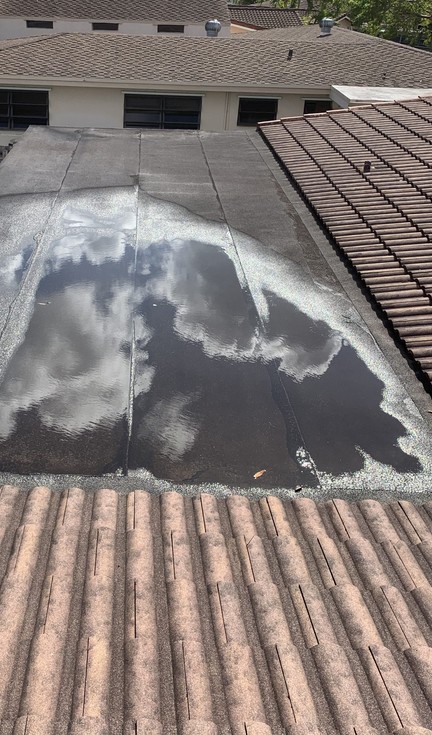
Drive through almost any Broward County neighborhood and you will see them: dark stripes running down roofs that otherwise look perfectly sound. They show up on newer homes and older ones, on shingle and on tile. And they never seem to rinse away, no matter how many afternoon storms roll through.
There is a reason for that. The streaks are not dirt, and they are not a stain in the usual sense. They are alive.
Those Streaks Are Algae, Not Dirt
The dark staining on South Florida roofs is a blue-green algae called Gloeocapsa magma. It thrives in warm, humid conditions, which describes Broward County for most of the year, and it feeds on the limestone filler used in asphalt shingles.
That explains the streaking pattern. The algae takes hold near the ridge, and every rainfall carries spores and nutrients down the slope, spreading the colony a little further. What you are looking at is not a dirty roof so much as a roof that has been colonised.
It also explains why rinsing accomplishes nothing. The organism has a root structure that sits down in the pores of the roofing material. Take the surface layer off and what remains simply grows back, usually within a season.
Why Late Summer Is Peak Streak Season
South Florida’s rainy season runs roughly from May into October, and by September a roof has had months of daily moisture and sustained humidity working in the algae’s favour. That is why so many homeowners notice the problem in early autumn. The growth did not appear overnight; it simply crossed the threshold from faint shadow to obvious stripe.
What Algae Actually Costs You
It is tempting to write the streaks off as a cosmetic annoyance. On a Broward County roof they are usually more than that:
- Accelerated granule loss. The algae’s root system can dislodge the protective granules on shingles, leaving them exposed to UV and shortening the roof’s usable life.
- Higher cooling costs. Dark staining absorbs more solar heat than a clean surface, which means a hotter attic and an air conditioner working harder than it needs to.
- It invites worse growth. Algae traps moisture, and trapped moisture is what lichen and moss need to establish. Those are considerably more destructive, and they can lead to wood rot.
- Curb appeal and property value. A streaked roof reads as a neglected roof to buyers and appraisers, whatever its actual condition.
- Air quality. Mold and mildew growing alongside the algae release spores, which matters to anyone in the household with allergies or respiratory sensitivity.
Shade Is the Hidden Accelerator
Two identical houses on the same street can age very differently, and the usual culprit is shade. A roof plane that stays damp for hours after sunrise because a tree canopy sits over it will stain far faster than one that dries in the morning sun.
Where limbs hang directly over the roofline, trimming them back is part of the fix rather than an afterthought. The principle is not unique to Florida, either: a tree service in Waltham, Massachusetts deals with the northern version of exactly the same problem, moss on perpetually shaded roofs, for exactly the same reason. Sunlight and airflow are what keep a roof surface hostile to organic growth.
Do Not Forget Where the Runoff Goes
When a roof is cleaned properly, dead algae and loosened debris come off it and go somewhere. That somewhere is your gutters, your downspouts and eventually your drainage. On a property where that line is already sluggish, a heavy debris load is what tips it into a genuine backup, which is the same failure mode drain and sewer specialists in San Antonio, Texas spend their days clearing. Clearing the gutters as part of the job keeps a clean roof from turning into a drainage problem.
Why Pressure Washing Is the Wrong Tool for a Roof
This is the part homeowners get wrong most often. High-pressure water will certainly remove the streaks. It will also strip granules off shingles, crack tile, and drive water underneath the roofing where it does not belong.
The correct method is soft washing. We apply a biodegradable cleaning solution at low pressure and let it do the work, penetrating the pores of the roofing material to kill the algae, mold and mildew at the root. After the solution has had time to act, the roof gets a gentle low-pressure rinse that carries away the dead organic matter. The result lasts because the organism is dead rather than merely displaced.
Before any solution is applied we inspect the roof, remove what needs moving, and pre-rinse the landscaping so the surrounding plants are protected. Our solutions are biodegradable and, applied properly, are safe around pets and plants. Soft washing is safe across the roofing materials common in Broward County, including asphalt shingle, clay and concrete tile, metal and slate.
How Often Should a Broward County Roof Be Cleaned?
As a general rule we suggest professional cleaning every two to three years in South Florida. Shade, roofing material and the immediate surroundings all shift that number. A roof under a heavy canopy may need attention sooner; one in full sun with good airflow can often go longer.
The honest test is visual. If you can see defined streaks from the street, the colony is well established and waiting another season only gives it more ground.
Get a Look at the Difference
You can see before-and-after results from jobs around Broward County on our recent projects page, and read more about how we approach roof cleaning in Broward County or the rest of our pressure cleaning services.
If the streaks have started showing on your roof, contact Super Kleen Pressure Cleaning for a free, no-obligation estimate. We will inspect the roof, tell you what we see, and give you an accurate quote.