Skip to content

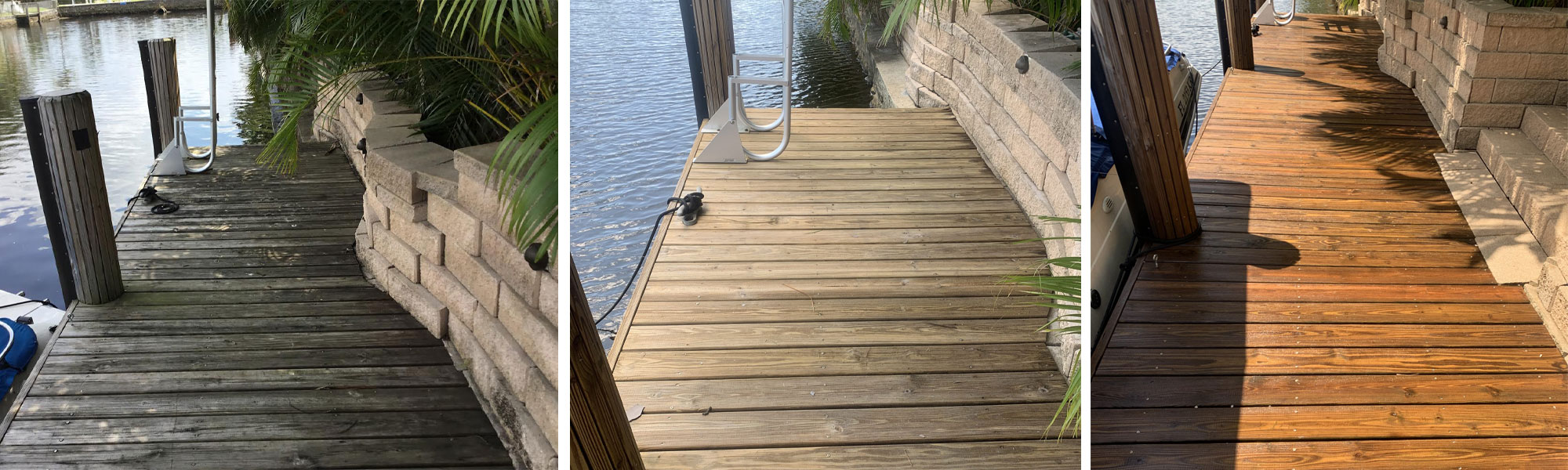
Most waterfront owners in Broward County ask this question the same way: after the dock has already gone green and slick, usually right after somebody nearly went into the water.
The short answer is at least once a year. The longer answer is that a dock in South Florida faces a combination of conditions almost nothing else on your property has to deal with, and the right interval depends on which of those conditions apply to yours.
The Baseline: Once a Year, Twice for Some Docks
Given how humid and salty our environment is, we suggest professional cleaning at least annually for docks in Broward County. Docks in high-traffic areas, and those that are particularly prone to algae growth, do better on a twice-yearly schedule.
If you are trying to work out which category yours falls into, the honest test is how it looks eleven months after its last cleaning. A dock that still looks reasonable at that point is on the right schedule. One that turned green by month six is telling you it needs attention twice a year.
Why Docks Grow Things So Much Faster Than the Rest of Your Property
A dock sits in what is effectively a permanent splash zone. Between tidal movement, boat wake, rain and the humidity coming off the water, the surface rarely gets a chance to dry out completely. Constant moisture is the single biggest driver of biological growth, and a dock has more of it than any driveway or patio ever will.
Salt makes it worse. Salt air is corrosive to hardware and fasteners, and salt deposits on decking hold moisture against the surface even on dry days. Add South Florida’s warmth and you have close to ideal conditions for algae, mold and mildew.
This Is a Safety Issue Before It Is a Cosmetic One
A biological film on decking is genuinely slippery when wet, and a dock is the worst possible place to lose your footing. People carry coolers and gear across them, often in bare feet, often in a hurry, frequently with children around, and the consequence of a slip is falling into open water rather than onto a lawn.
If you take nothing else from this, take that. The annual interval is not really about appearance.
Different Materials, Different Methods
Dock cleaning is not one technique applied everywhere. We tailor the method to what the dock is actually made of.
Wood is the material that gets damaged most often by well-meaning cleaning. High-pressure washing causes splintering and strips away the natural fibres of the timber, leaving a surface that is rougher, more absorbent and quicker to grow algae than it was before. For wood docks we primarily use a soft washing technique, which is gentle on the surface but still tough on the contaminants.
Composite decking resists rot but still develops surface growth in the seams and texture, and it has its own tolerances that need respecting. Concrete handles more aggressive treatment than either, though there is still such a thing as too much.
What Goes Into the Water Matters
Anything used on a dock ends up in the waterway underneath it. That is not a small consideration when your dock sits over a canal or the Intracoastal.
We use only biodegradable, eco-friendly cleaning solutions that are safe for the surrounding waterways and marine life. It is worth asking any contractor you consider the same question before they start, because a dock is one of the few surfaces where the runoff has nowhere neutral to go.
What Is Growing Above the Dock Affects What Grows On It
Waterfront lots are often heavily planted, and overhanging palms and hardwoods do two things to a dock. They drop fronds, leaves and seed litter onto the decking, where the debris holds moisture against the surface. And they shade the deck, so it stays wet for hours longer after rain than an exposed one would.
Keeping canopy trimmed back off the dock is one of the cheapest ways to lengthen the interval between cleanings, and it is standard maintenance advice from any competent arborist, including a tree care company in Southern California working an entirely different climate. Debris load and shade drive surface growth everywhere.
While You Are Out There, Check the Hardware
Cleaning day is a good opportunity to look at the things you normally walk straight past. Salt air is hard on metal, and dock boxes, gate hardware, cleats and any storage locker at the head of the dock corrode faster than equivalent hardware anywhere else on the property.
Seized or rusted-out locks on waterfront storage are a routine call for a locksmith in Dallas, Texas and for locksmiths in every coastal market, and it is far easier to deal with a stiff lock than a seized one. A clean dock with a storage box you can no longer open is only half a result.
How to Prepare for a Dock Cleaning
The main thing we ask is that the boat be moved for the appointment. It gives access to the full deck surface, including the areas along the edge that are usually the dirtiest, and it keeps the vessel clear of the work entirely. Clearing furniture, rod holders and loose gear off the dock beforehand speeds things up as well.
Book Before the Season Gets Away From You
If your dock has not been cleaned this year, now is a sensible time. The rainy season has done its work by early autumn, and getting the growth off before the busy winter boating months means the deck is safe when you are actually using it.
Read more about our approach to boat dock cleaning in Broward County, see recent work on our recent projects page, or look through the rest of our pressure cleaning services.
To get on the schedule, contact Super Kleen Pressure Cleaning for a free, no-obligation estimate.